Open-Pollinated vs. Hybrid Seeds: You Do Not Have to Pick a Side
A tomato that tastes like the one your grandparents grew, a cucumber bred to resist a common disease, and a packet of zinnias that produces three colors you did not expect can all belong in the same garden.
The plants will not argue about it.
Gardeners sometimes talk about open-pollinated vs. hybrid seeds as though we are being asked to choose sides. One is presented as old, flavorful, and good. The other is modern, uniform, and somehow suspicious.
Gardens are more interesting than that.
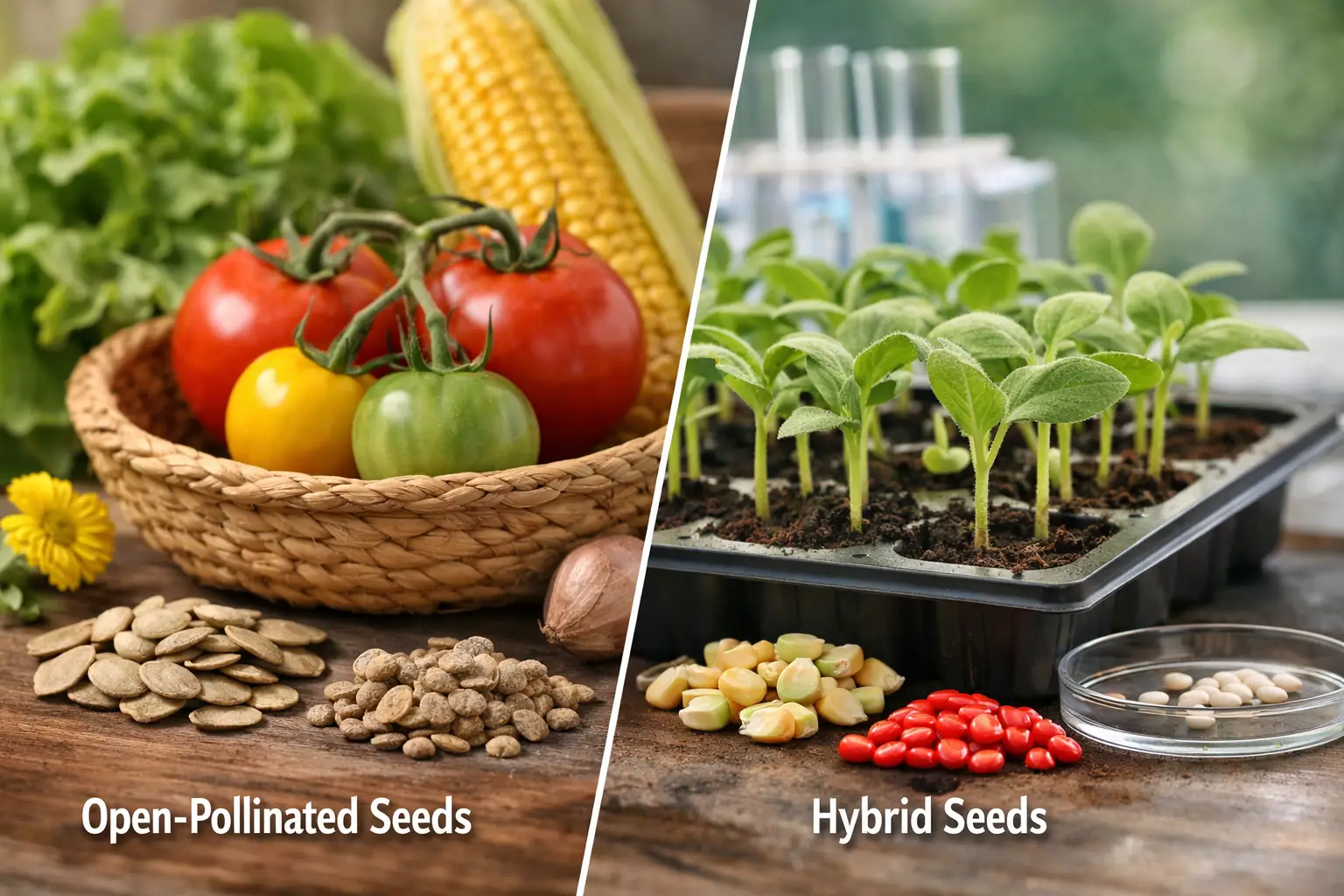
Open-pollinated and hybrid seeds are simply different ways of producing a variety. Each can be useful. Each can grow beautifully. Each can also disappoint you under the right combination of weather, timing, pests, and plain bad luck.
The useful question is not, “Which kind of seed is better?”
It is, “What do I want this plant to do?”
Once you understand that, the labels become much less intimidating.
What Are Open-Pollinated Seeds?
Open-pollinated plants are pollinated naturally by insects, wind, birds, or sometimes themselves.
When an open-pollinated plant receives pollen from the same variety, the seeds it produces will generally grow into plants that resemble their parents. That makes open-pollinated varieties useful for gardeners who want to save seeds and grow them again.
Save seeds from an open-pollinated tomato you loved, prevent it from crossing with another variety, and next year’s plants should produce similar tomatoes.
That is the basic promise.
Not absolute perfection. Plants are living things, and a little natural variation is normal. One tomato may be slightly larger. One zinnia may bloom in a shade you did not expect. One bean plant may mature a few days earlier than the others.
For a commercial grower who needs every tomato to fit into the same box, that variation can be inconvenient.
For a home gardener, it can be part of the fun.
Open-pollinated varieties can also adapt gradually to local conditions when gardeners save seeds from the plants that perform best. If you repeatedly save seed from tomatoes that handle your hot summers, short season, or humid weather, you may slowly favor plants that are better suited to your garden.
That kind of relationship with a variety takes time.
Fortunately, gardens are built one season at a time.
Where Do Heirloom Seeds Fit In?
Most heirloom seeds are open-pollinated, but not every open-pollinated seed is an heirloom.
“Heirloom” is not a tightly regulated scientific category. It generally describes an older open-pollinated variety that has been preserved and passed down over many years. Some have been grown by families or communities for generations. Others were once popular commercial varieties that gardeners kept alive after larger growers moved on.
An heirloom may carry a family story, a regional history, or simply a reputation for being too delicious to lose.
A newer variety can also be open-pollinated. It may have been developed recently through years of careful selection and still produce seeds that grow true to type.
So the easiest way to remember it is this:
Every heirloom is generally open-pollinated, but not every open-pollinated variety is old enough to be called an heirloom.
If you want the fuller story, our guide to what heirloom vegetable seeds really are explains where the name comes from and why these varieties still matter.
What Are Hybrid Seeds?
A hybrid seed is created by intentionally crossing two different parent lines of the same species.
Plant breeders choose parents with particular strengths and combine them in hopes of producing a first generation with the best traits of both. That first generation is usually labeled F1.
One parent might contribute disease resistance.
Another might contribute flavor, early maturity, compact growth, or uniform fruit.
The resulting hybrid is not automatically better than either parent, but it has been bred to do something specific.
That “something” can be genuinely useful.
A gardener who loses cucumbers to powdery mildew every summer may benefit from a resistant hybrid. Someone growing tomatoes on a small patio may appreciate a compact hybrid developed for containers. A gardener who wants fifty paste tomatoes ready within a short period for one enormous sauce-making weekend may value uniform ripening.
Hybrids are tools.
Whether you need that tool depends on your garden.
Hybrid Does Not Mean Genetically Modified
This is worth saying clearly because the terms are often confused.
A hybrid seed is not the same as a genetically modified seed.
Hybrids are produced through controlled pollination. Breeders select two compatible parent plants and move pollen from one to the other. It is a guided version of something plants and pollinators already do.
Genetic modification uses laboratory methods to alter a plant’s genetic material in ways that do not occur through ordinary pollination.
They are not the same process.
A seed can be hybrid and non-GMO. An open-pollinated seed can also be non-GMO.
If you have encountered all these labels on seed packets and wondered how they fit together, our guide to non-GMO heirloom vegetable seeds separates the useful information from the marketing language.
Can You Save Seeds From a Hybrid?
You can save them.
The more important question is what will grow.
Seeds collected from an F1 hybrid may germinate perfectly well, but their offspring will not reliably resemble the hybrid plant. The next generation can separate into many combinations of traits inherited from its grandparents.
You might get something wonderful.
You might get something unremarkable.
You might grow a tomato plant that produces six oddly shaped fruits in late September after occupying a prime garden spot all summer.
Plant breeding begins with this kind of variation, so growing seeds from a hybrid can be an interesting long-term experiment. But it may take several generations of selection before the traits become stable and predictable.
If you want to save seeds and grow the same variety again next year, open-pollinated seeds are the simpler choice.
Beans, peas, lettuce, and tomatoes are particularly good crops for beginning seed savers because they are largely self-pollinating. Squash, pumpkins, cucumbers, corn, and many flowers cross more readily and require additional planning if you want their seeds to remain true to type.
Start with one easy crop.
Label it well.
Save seeds from the healthiest plants that gave you something worth growing again.
You will learn more from saving one variety successfully than from filling twenty envelopes with seeds you can no longer identify by February.
The Differences That Actually Matter
Open-pollinated seeds are often a good choice when you care about:
- Saving seeds for future seasons
- Growing unusual or older varieties
- Flavor and variety
- Preserving family or regional favorites
- Selecting plants that perform well in your garden
- Allowing a little natural variation
Hybrid seeds can be a good choice when you want:
- Resistance to a specific disease
- More uniform size or maturity
- A compact plant for containers
- A concentrated harvest
- A particular color, shape, or growing habit
- Predictable performance under certain conditions
But neither label guarantees a great garden.
An open-pollinated tomato can be wonderfully productive. Another may struggle with the diseases common in your area.
A hybrid cucumber may resist powdery mildew and still fail if it is planted in cold soil, forgotten during a hot week, or discovered by cucumber beetles.
Seeds have strengths.
They do not have superpowers.
Sun, soil, water, drainage, timing, and attention still matter. Often, choosing a variety suited to your climate and growing season is more important than whether the packet says open-pollinated or hybrid.
What About Flavor?
Heirloom tomatoes have earned a reputation for flavor, and often deservedly so.
A perfectly ripe heirloom tomato eaten warm from the garden can make a supermarket tomato seem like an entirely different vegetable.
But “heirloom” does not automatically mean delicious, and “hybrid” does not automatically mean bland.
Flavor depends on the variety, growing conditions, ripeness, and the person eating it. One gardener’s perfect tomato is sweet and mild. Another wants acidity strong enough to announce itself from the other side of the sandwich.
The only reliable solution is to taste more tomatoes.
Grow a cherry tomato, a slicer, and a paste variety. Plant an old favorite beside something unfamiliar. Keep a simple note about flavor, productivity, disease, and whether you would grow it again.
Our guide to choosing and growing tomato seeds can help you compare the differences that matter in an actual garden.
A label can tell you how a seed was produced.
It cannot tell you which tomato you will reach for first.
Uniformity Is Not Always a Home-Garden Advantage
Uniformity is valuable in commercial agriculture.
If thousands of heads of lettuce need to be harvested, packed, and shipped on schedule, having them mature together at a similar size makes sense.
Most home gardeners do not need every tomato to ripen on the same Tuesday.
In fact, that can become its own problem.
A little variation may spread the harvest over several weeks. One bean plant starts producing while another is still flowering. One lettuce grows faster while another holds a little longer. Dinner arrives in manageable amounts instead of all at once.
Uniformity can still be useful if you are canning, freezing, selling produce, or trying to create a very formal flower display.
But do not assume that uniform automatically means better.
Sometimes the slightly untidy garden feeds you longer.
Plant for the Garden You Actually Have
If you have a short growing season, look closely at days to maturity. An early hybrid may be useful, but there are also fast open-pollinated varieties.
If disease regularly ruins a particular crop, resistance may matter more than history.
If you garden in containers, mature plant size matters. A sprawling indeterminate tomato may be wonderful, but only if you have room for the plant and a support sturdy enough to hold it.
If you want to save seeds, grow open-pollinated varieties and begin with crops that are easy to keep true.
If this is your first garden, choose vegetables you actually want to eat. A technically fascinating variety has limited value if nobody in the house likes it.
Our Easy Vegetables to Grow offer a good starting point for building confidence. They were selected because they germinate readily, grow reliably, and give new gardeners a reasonable chance to see something happen.
Fast wins matter.
A radish pulled from the soil, a bean found under the leaves, or the first tomato turning color gives a new gardener a reason to plant again.
You Can Grow Both
You do not have to commit your entire garden to one seed philosophy.
Grow a disease-resistant hybrid tomato because you want a dependable harvest.
Beside it, plant an open-pollinated tomato you want to taste and possibly save.
Use a compact hybrid cucumber on the patio and an old open-pollinated variety along the fence.
Plant a uniform row of flowers where you want a particular color, then scatter open-pollinated varieties somewhere they can surprise you.
The garden will not become confused.
Mixing types can actually teach you more. You will see how the varieties respond to the same soil, weather, watering, and pests. One may clearly outperform the other. The result may be the opposite of what the catalog suggested.
That is useful information because it belongs to your garden.
Plant a Favorite and Then Plant a Surprise
There is comfort in growing something you already know.
Maybe it is the same tomato your family has grown for years. Maybe it is the dependable cucumber that fills the refrigerator every July. Maybe it is a marigold that seems willing to bloom no matter what the summer does.
Plant it again.
Then plant something you know almost nothing about.
That is the thinking behind planting more than one variety. It spreads the risk, extends the harvest, and makes the garden more interesting.
One variety may love a cool spring.
Another may wake up when summer gets hot.
One may shrug off a disease that troubles the rest.
And sometimes the inexpensive packet added to the order on a whim becomes the variety you talk about all winter.
That happens more often than gardening plans would like to admit.
Do Not Let the Label Make the Decision for You
When choosing seeds, start with the things that will affect your garden most:
- Does the crop fit your space?
- Will it mature during your growing season?
- Does it resist a disease you regularly encounter?
- Do you actually want to eat it or look at it?
- Do you want to save its seeds?
- Does it sound interesting enough to try?
Then look at whether it is open-pollinated, heirloom, or hybrid.
At DollarHeirloom, we focus on heirloom and open-pollinated seeds because we love the variety, history, flavor, and freedom to save them. We also believe gardeners should be able to experiment without every new variety feeling like a financial decision.
That does not require pretending hybrids have no place in a garden.
A good garden is not built by loyalty to a label.
It is built by paying attention.
Grow what works. Save what is worth saving. Replace what disappoints you. Try the purple bean, the striped tomato, the oddly named lettuce, or the flower you bought mostly because the picture made you happy.
A seed packet is a small wager on the season ahead.
Some will become reliable favorites.
Some will fail spectacularly.
And a few will surprise you enough to change what you plant next year.
That may be the best reason to leave room for both certainty and curiosity.
Happy gardening, The DollarHeirloom Team